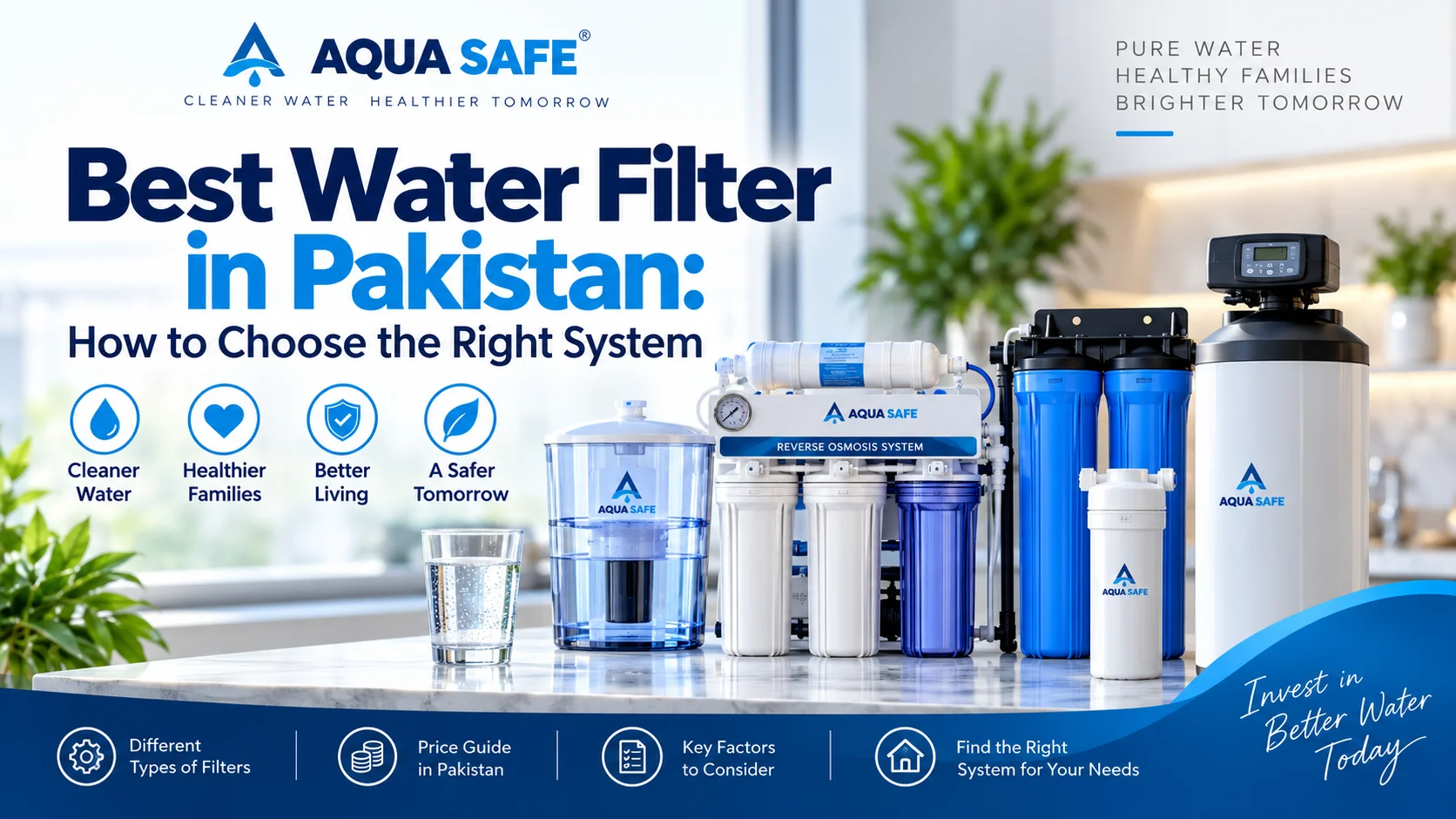
Best Water Filter in Pakistan: How to Choose the Right System
Finding the best water filter in Pakistan is not simply about choosing the most expensive filtration system. The right water filter depends on your water quality, household size, contaminants, daily consumption, available space, maintenance requirements, and budget. A system that works well for one home may not be the right choice for another.
Water quality can vary considerably across Pakistan. Tap water, bore water, tanker water, and municipal supplies can have different levels of sediment, hardness, dissolved salts, chlorine, unpleasant taste, and other contaminants. This is why understanding filtration technology before buying a water filter is important.
In this guide, we explain the major types of water filtration systems available in Pakistan, how they work, what situations they are suitable for, and the key factors you should consider when choosing a filtration system for your home, office, business, or commercial facility.
What Is a Water Filter?
A water filter is a treatment system designed to reduce unwanted substances from water and improve its quality. Depending on the technology used, a filtration system can target sediment, chlorine, unpleasant odors, certain chemicals, microorganisms, dissolved solids, and other impurities.
Not every water filter removes every type of contaminant. For example, a sediment filter is mainly designed to capture physical particles, while activated carbon is commonly used to improve taste and reduce chlorine and certain organic compounds. Reverse osmosis systems use a semipermeable membrane to reduce many dissolved substances, including total dissolved solids (TDS).
Therefore, the best water filter in Pakistan should be selected according to the actual quality and intended use of your water rather than based only on the number of filter stages.
Why Water Quality Should Come First
Before purchasing a filtration system, you should understand the water entering your home or business.
Water may appear clean while still containing dissolved substances that cannot be seen with the naked eye. Similarly, cloudy water may indicate suspended particles that can often be addressed with sediment filtration.
Common water-quality concerns can include:
- Sand and dirt
- Rust particles
- Sediment
- Chlorine
- Unpleasant taste or odor
- Hardness
- High TDS
- Certain dissolved minerals
- Microbiological contamination
The exact treatment required depends on the source and quality of the water.
For this reason, a water-quality test can be a useful first step when choosing between a basic filter, multi-stage filtration system, water softener, or RO system.
What Is the Best Water Filter in Pakistan?
There is no single filtration system that is automatically the best for every situation.
For many households, a multi-stage domestic filtration system can provide practical treatment for everyday drinking water. Where dissolved solids are high, an RO system may be more appropriate. If the main problem is sediment, a sediment filtration system may be sufficient. If hardness is the primary concern, a water softener may be a better solution than an RO unit.
The best choice is therefore the system that matches your water quality, usage, treatment requirements, and maintenance capacity.
A good selection process starts with four questions:
- Where does your water come from?
- What contaminants or water-quality problems need to be addressed?
- How much treated water does your household or business need?
- What level of maintenance can you manage?
Answering these questions makes it much easier to narrow down the right filtration technology.
Types of Water Filters Available in Pakistan
Pakistan has a wide range of domestic and commercial filtration solutions. The following are some of the most commonly used technologies.
Sediment Water Filters
Sediment filters are designed to remove suspended physical particles from water.
They can help capture materials such as sand, dirt, rust particles, and other larger sediments. Sediment filtration is often used as a first stage because it can protect subsequent filtration components from excessive particulate buildup.
A sediment filter may be suitable when your water contains visible particles or when sediment is affecting plumbing fixtures and other filtration equipment.
However, sediment filtration does not solve every water-quality problem. It does not, by itself, provide comprehensive treatment for dissolved salts or all microorganisms.
Activated Carbon Filters
Activated carbon filtration is commonly used to improve the taste and smell of drinking water.
Carbon can reduce chlorine and certain organic compounds that contribute to unpleasant taste and odor. It is frequently included as one stage within a multi-stage domestic filtration system.
For households receiving treated municipal water where taste or chlorine is the primary concern, carbon filtration can be an important part of the treatment process.
The performance of a carbon filter depends on the type and quality of the carbon, contact time, water conditions, and cartridge replacement schedule.
Multi-Stage Water Filters
Multi-stage systems combine different filtration technologies in one unit.
A typical system may include sediment filtration, activated carbon filtration, and additional treatment stages depending on the design. The purpose is to address different categories of impurities through separate filtration stages.
For households looking for a practical drinking-water solution, a multi-stage system can be attractive because different stages perform different functions.
However, more stages do not automatically mean better water. The filtration stages should be selected according to the actual water-quality requirements.
Reverse Osmosis Water Filters
Reverse osmosis, commonly known as RO, is one of the most advanced water-treatment technologies used in residential and commercial applications.
An RO system forces water through a semipermeable membrane. The membrane can significantly reduce many dissolved substances, including salts and other contaminants, depending on the system and operating conditions.
RO is particularly relevant in areas where water has high TDS or where dissolved contaminants are a major concern.
A domestic RO system may include pre-filters, an RO membrane, post-treatment, and a storage tank. More advanced systems can include additional treatment or monitoring features.
Because RO membranes require suitable pretreatment and maintenance, users should not choose an RO system solely because it has more filtration stages. The entire system should be appropriate for the incoming water.
UV Water Purification
Ultraviolet treatment uses UV light as a disinfection method. When properly designed and operated, UV systems can help inactivate microorganisms in water.
UV treatment is different from sediment or carbon filtration because it does not primarily remove physical particles or dissolved salts. This means UV is often used alongside other treatment technologies rather than as a complete filtration solution by itself.
For water sources where microbiological safety is a concern, UV can be an important component of a properly designed treatment system.
Water Softeners
A water softener is designed specifically to address hardness.
Hard water can cause scale buildup in pipes, water heaters, bathroom fixtures, and appliances. It can also affect soap performance and leave mineral deposits on surfaces.
Water softeners use ion-exchange technology to reduce hardness-causing minerals such as calcium and magnesium.
A softener is not the same thing as a drinking-water filter. In many homes, a softener and a drinking-water filtration system may serve different purposes.
Whole-House Water Filtration Systems
Whole-house filtration treats water at or near the main entry point so that multiple outlets receive treated water.
This approach can be useful for larger homes, buildings, offices, and other properties where water-quality concerns extend beyond drinking water.
Depending on the water source, a whole-house system may combine sediment filtration, carbon filtration, softening, or other treatment technologies.
The appropriate configuration should be determined by water testing and the property’s specific requirements.
How to Choose the Best Water Filter in Pakistan

Choosing the right system becomes easier when you evaluate several important factors.
1. Test Your Water Quality
Water testing should be one of the first steps in selecting a filtration system.
Important parameters can include TDS, hardness, pH, turbidity, and microbiological indicators, depending on the water source and intended use.
Testing helps prevent a common mistake: buying a filtration system based on assumptions rather than actual water conditions.
For example, if your main problem is high dissolved solids, a simple sediment filter may not provide the treatment you need. Likewise, if your primary concern is sediment, installing an unnecessarily complex system may increase cost and maintenance without providing meaningful additional value.
2. Consider Your Water Source
The source of your water can influence your filtration requirements.
Municipal water may have different treatment needs from bore water. Tanker-supplied water can also vary depending on its source and storage conditions.
Consider whether your property uses:
- Municipal water
- Bore water
- Tanker water
- Stored water
- A combination of sources
If your water source changes seasonally or frequently, regular testing can help ensure that your treatment system remains suitable.
3. Determine Daily Water Consumption
Household size matters when selecting a water filter.
A small household with limited drinking-water consumption may not require the same capacity as a large family. Commercial offices, restaurants, schools, clinics, and factories can have significantly higher requirements.
When comparing systems, look beyond the purchase price and consider production capacity, storage capacity, recovery, and expected daily demand.
4. Understand TDS
TDS stands for total dissolved solids and is commonly discussed when purchasing water filtration systems in Pakistan.
A high TDS reading can indicate the presence of dissolved minerals and salts. However, TDS alone does not identify exactly which substances are present or determine whether water is microbiologically safe.
This is why TDS should be considered alongside other water-quality parameters rather than used as the only measure of water safety.
RO technology can be particularly useful where reducing dissolved solids is a primary treatment objective.
5. Check Filter Replacement Requirements
Every filtration system requires maintenance.
Filter cartridges have a limited service life and eventually need replacement. RO membranes can also require replacement depending on water quality, usage, pretreatment, and operating conditions.
Before purchasing, ask:
- How often do cartridges need replacement?
- Which cartridges are required?
- Is replacement readily available?
- What is the expected membrane life?
- How much does routine maintenance cost?
A slightly cheaper filtration system can become expensive if replacement parts are difficult to find or maintenance costs are high.
6. Look at Build Quality
The quality of the housing, cartridges, fittings, membrane, pump, storage tank, and other components can affect the long-term performance of a filtration system.
When comparing systems, don’t focus only on the number of stages. Look at the actual components being used.
A well-designed system with appropriate components can be more valuable than a system marketed with a large number of stages but poorly matched to the incoming water.
7. Consider Installation Space
Available space is another practical consideration.
Under-sink systems are useful when you want drinking-water treatment without taking up significant kitchen space. Larger RO systems, whole-house filters, and commercial systems require more installation space.
Before purchasing, consider where the system will be installed and whether appropriate drainage, electricity, plumbing connections, and maintenance access are available.
8. Think About Water Wastage
RO systems can produce reject water as part of their purification process.
The amount of reject water depends on system design, membrane condition, incoming water quality, pressure, temperature, and other operating conditions.
If you are installing an RO system, ask the supplier about its recovery ratio and whether reject water can be reused for suitable non-drinking purposes.
9. Choose a Reliable Supplier
The supplier is almost as important as the filtration equipment.
A reliable water filtration company should be able to explain the system, recommend appropriate components, provide installation support, and supply replacement filters when required.
Before buying, check the availability of after-sales service and replacement cartridges.
This becomes especially important for RO systems because proper maintenance can affect membrane performance and overall water quality.
Best Water Filter for Different Situations
The right filtration technology depends on your specific requirements.
| Requirement | Potentially Suitable System |
|---|---|
| Sand, dirt and rust | Sediment filter |
| Chlorine, taste and odor | Activated carbon filter |
| Multiple common impurities | Multi-stage filtration |
| High TDS or dissolved salts | RO system |
| Microbiological disinfection | UV treatment |
| Hard water and scale | Water softener |
| Treatment for multiple outlets | Whole-house filtration |
| High-volume commercial use | Commercial RO/filtration system |
This table should be treated as a starting point rather than a substitute for water testing and professional assessment.
Domestic vs Commercial Water Filtration
A domestic water filter is designed around household consumption and space limitations.
Commercial filtration systems have different requirements. Restaurants, offices, schools, hospitals, hotels, and manufacturing facilities may require substantially higher water production and more robust equipment.
Commercial systems may use larger membranes, higher-capacity pumps, larger storage tanks, pre-treatment systems, and automated controls.
If your requirement is commercial, don’t simply install several domestic systems without evaluating the actual flow rate and daily demand. A properly sized commercial filtration system can be more practical and easier to maintain.
Common Mistakes to Avoid When Buying a Water Filter
One of the biggest mistakes is choosing a filter only because it has a high number of stages.
A seven-stage or ten-stage system is not automatically better than a four-stage system. The important question is whether those stages address the contaminants present in your water.
Another mistake is ignoring replacement costs. A filtration system is a long-term purchase, so the total cost of ownership matters.
Some buyers also focus only on TDS. While TDS is useful, it does not tell you everything about water quality.
Finally, avoid buying a system without considering after-sales service. Even a good filtration system can perform poorly if filters are not replaced or the equipment is not maintained correctly.
How Much Does a Good Water Filter Cost in Pakistan?
The price of a water filter in Pakistan can vary significantly depending on technology, capacity, brand, components, installation, and intended application.
Basic sediment and carbon filters are generally less expensive than advanced RO systems. Domestic RO systems typically cost more because they include additional components such as membranes, pumps, storage tanks, and multiple filtration stages.
Commercial and industrial systems can cost substantially more because they are designed for higher flow rates and larger daily water requirements.
Instead of asking only, “What is the cheapest water filter?”, consider the total value:
Purchase price + installation + replacement filters + maintenance + operating cost
This gives you a more realistic picture of the investment.
Why Aqua Safe Can Be Considered for Water Filtration Solutions
When choosing a filtration system, customers should look for a supplier that offers solutions for different water-quality requirements rather than recommending the same product to every customer.
Aqua Safe provides water filtration and purification solutions covering domestic water filters, reverse osmosis systems, commercial plants, water softeners, cartridges, and accessories.
The right product should still be selected according to your water quality and usage requirements. If you are unsure which system is suitable, getting your water tested and discussing the results with a qualified filtration professional is a sensible approach.
Frequently Asked Questions
Which is the best water filter in Pakistan?
The best water filter in Pakistan depends on your water quality and treatment requirements. A multi-stage filter may be suitable for some households, while an RO system may be more appropriate for water with high dissolved solids. Water testing is the best starting point.
Is RO better than a normal water filter?
RO provides a different level of treatment from basic sediment or carbon filtration and can reduce many dissolved substances. However, RO is not automatically necessary for every water source. The right technology depends on the contaminants that need to be addressed.
Which water filter is best for high TDS?
RO is commonly used when reducing high dissolved solids is a major treatment objective. However, the complete system should be selected based on water analysis, because high TDS alone does not identify every water-quality issue.
How often should water filters be replaced?
Replacement frequency depends on filter type, water quality, consumption, and manufacturer recommendations. Filters exposed to high sediment loads may require more frequent replacement, while carbon cartridges and RO membranes have their own service intervals.
Is a water filter enough for drinking water?
It depends on the water source and the filtration technology. Some filters address physical particles or taste, while others are designed for dissolved substances or microbial treatment. A properly designed treatment system should match the specific risks identified in the water.
Should I buy a 5-stage or 7-stage water filter?
The number of stages should not be the primary deciding factor. Compare the actual filtration technologies and components used in each stage and determine whether they address your water-quality requirements.
Is a water softener the same as an RO system?
No. A water softener primarily reduces hardness-causing minerals, while RO uses a membrane to reduce many dissolved substances. They serve different purposes and can sometimes be used together.
Final Thoughts
Choosing the best water filter in Pakistan requires more than comparing prices or counting filtration stages. The most suitable system is the one designed around your actual water quality, daily consumption, required treatment, available space, maintenance needs, and budget.
Start by testing your water. Identify whether your main concern is sediment, chlorine, hardness, high TDS, microorganisms, or a combination of factors. Then choose the filtration technology that specifically addresses those requirements.
For a household, a properly selected domestic filtration system may provide an effective solution. For high-TDS water, an RO system may be more appropriate, while commercial properties may require higher-capacity filtration and purification equipment.
The goal should always be appropriate water treatment rather than simply buying the most expensive system. With proper water analysis, suitable equipment, quality components, and regular maintenance, you can make a more informed long-term investment in your water filtration system.

About author



Add comment