RO Plant Price in Pakistan: Complete 2026 Buying Guide
If you are searching for RO plant price in Pakistan, the cost can vary significantly depending on the plant’s capacity, membrane quality, filtration stages, automation, material, installation requirements, and intended application. A small commercial RO system for a shop or office may cost considerably less than a large industrial RO plant designed to process thousands of litres of water per hour.
Choosing an RO plant should not be based on price alone. The right system needs to match your water source, daily water consumption, required purification level, and operating environment. This guide explains the factors that influence RO plant price in Pakistan, the different types of RO plants available, expected costs, maintenance requirements, and how to choose a reliable water treatment solution in 2026.
What Is an RO Plant?
An RO plant, or Reverse Osmosis plant, is a water purification system that uses a semi-permeable membrane to remove dissolved salts, minerals, contaminants, and other impurities from water.
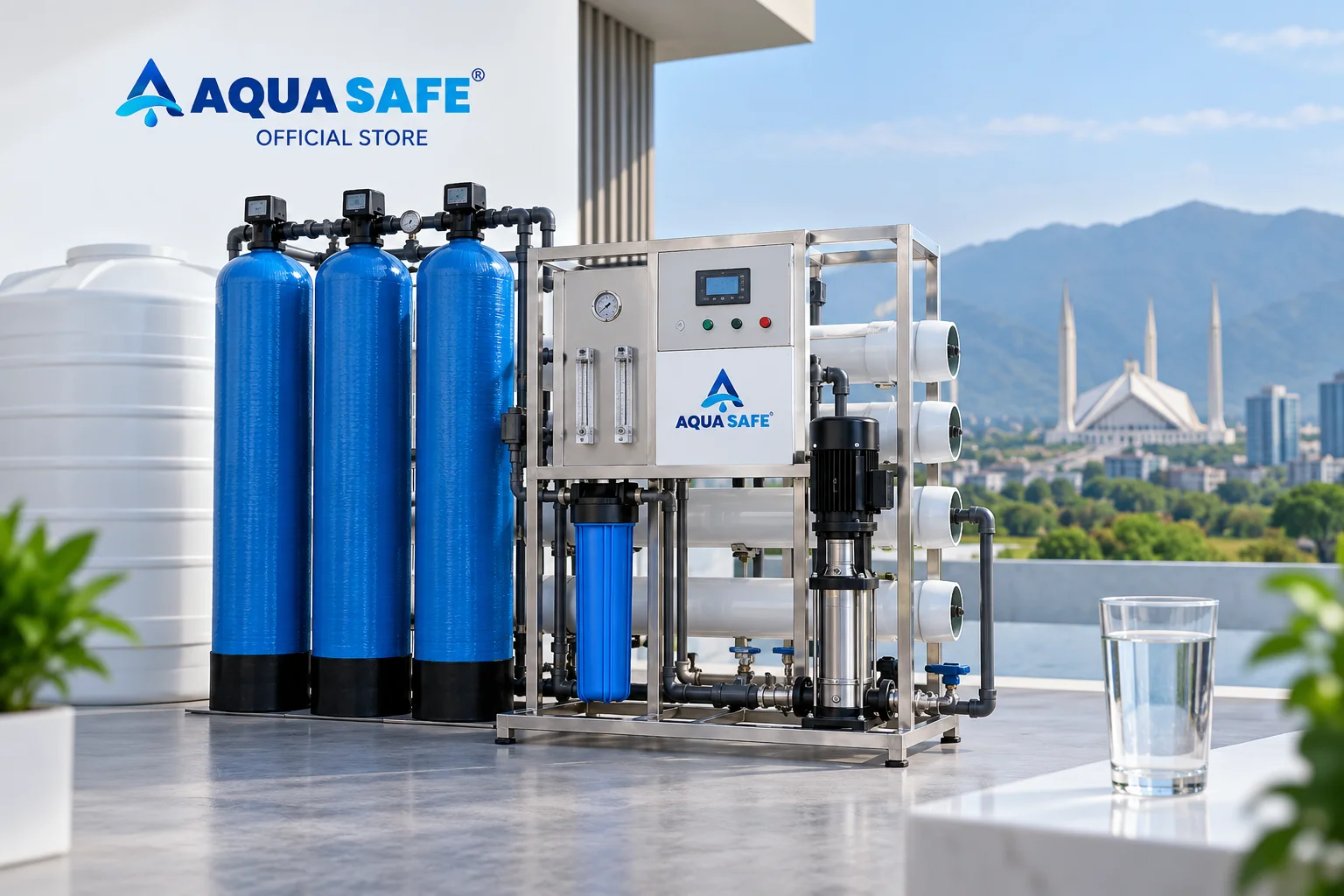
In a typical reverse osmosis system, water passes through several stages of treatment before reaching the RO membrane. Depending on the application, the system may include sediment filters, activated carbon filters, micron filters, high-pressure pumps, RO membranes, storage tanks, UV treatment, ozone systems, and post-treatment filtration.
RO technology is commonly used for drinking water, commercial water production, food and beverage businesses, hospitals, laboratories, educational institutions, hotels, factories, and other applications where water quality needs to be controlled.
How Much Does an RO Plant Cost in Pakistan in 2026?
The RO plant price in Pakistan does not have one fixed rate because RO systems are available in different capacities and configurations.
As a general market guide, smaller commercial RO systems can start from tens of thousands of rupees, while larger commercial and industrial systems can reach several hundred thousand or even millions of rupees.
The approximate price structure can be understood as follows:
| RO Plant Type | Typical Capacity | Approximate Price Range |
|---|---|---|
| Small Commercial RO Plant | 250–500 GPD | Rs. 50,000–150,000+ |
| Commercial RO Plant | 1,000–2,000 GPD | Rs. 100,000–300,000+ |
| Medium Commercial RO Plant | 3,000–5,000 GPD | Rs. 250,000–600,000+ |
| Industrial RO Plant | 10,000+ GPD | Rs. 500,000–1,500,000+ |
| Large Industrial RO Plant | Custom capacity | Rs. 1,500,000+ |
These figures should be treated as indicative ranges rather than fixed quotations. The final cost depends on the specifications of the system, water analysis, components, installation, automation and site requirements.
For an accurate quotation, it is better to have the raw-water quality and required production capacity assessed before purchasing a plant.
What Determines RO Plant Price in Pakistan?

Several factors directly influence the cost of an RO system. Understanding these factors can help you compare quotations more accurately.
1. RO Plant Capacity
Capacity is one of the most important factors affecting price.
An RO plant designed to produce 500 gallons per day will generally cost much less than a plant capable of producing 10,000 or 20,000 gallons per day.
Before purchasing, calculate your actual water requirement. Installing an unnecessarily large plant increases the initial investment as well as electricity, membrane, maintenance, and replacement costs.
2. Water Quality
The quality of your incoming water has a major impact on system design.
Water from different sources can contain different concentrations of total dissolved solids, hardness, iron, sediment, organic matter, and other contaminants. A system designed for relatively clean municipal water may not be suitable for untreated bore water.
For this reason, a professional water analysis can be extremely useful before selecting an RO plant.
3. Number and Quality of Filtration Stages
An RO plant usually works as part of a multi-stage treatment process.
Pre-treatment can include:
- Sediment filtration
- Activated carbon filtration
- Sand or multimedia filtration
- Micron filtration
- Water softening
- Iron removal
- Antiscalant dosing
The exact configuration depends on the quality of the raw water.
Better-quality filtration components can increase the initial RO plant price in Pakistan, but they may also protect the RO membranes and improve overall system performance.
4. RO Membrane Quality
RO membranes are one of the most important components of a reverse osmosis plant.
Membrane quality affects purification performance, recovery, operating pressure, and replacement costs. Using low-quality membranes simply to reduce the initial purchase price may result in higher maintenance expenses over time.
A good purchasing decision should consider both membrane performance and long-term replacement availability.
5. High-Pressure Pump
The RO membrane requires appropriate operating pressure. The high-pressure pump must therefore be correctly selected according to the plant capacity and water conditions.
Pump quality can influence:
- Electricity consumption
- Operating stability
- Pressure consistency
- Maintenance requirements
- Overall plant life
A properly sized pump is more important than simply selecting the most powerful pump available.
6. Automation Level
RO plants can range from relatively simple manually operated systems to highly automated plants.
Automation may include:
- Automatic flushing
- Low-pressure protection
- High-pressure protection
- Auto-start and stop
- Level sensors
- Digital monitoring
- Conductivity/TDS monitoring
- Flow meters
- Control panels
More advanced automation increases the initial investment but can make the plant easier to operate and monitor.
Types of RO Plants Available in Pakistan
Different businesses require different RO systems. Understanding the main categories can help you identify the right solution.
Domestic RO Systems
Domestic RO systems are designed primarily for household drinking and cooking water.
They are compact and generally installed under a kitchen counter or in a dedicated location. These systems typically have lower production capacity than commercial plants.
If your requirement is simply safe drinking water for a family, a domestic RO system may be more appropriate than investing in a commercial RO plant.
Commercial RO Plants
Commercial RO plants are designed for businesses and organizations that need larger quantities of purified water.
They can be used in:
- Restaurants
- Cafes
- Offices
- Schools
- Clinics
- Hotels
- Water shops
- Small manufacturing businesses
Commercial RO systems are available in different capacities, making it possible to select a plant according to daily demand.
Industrial RO Plants
Industrial RO plants are designed for high-volume applications.
Factories and large facilities may require thousands or tens of thousands of litres of treated water every day. These systems can be engineered with additional pre-treatment, multiple membranes, dosing systems, automated controls, and other treatment technologies.
Because industrial plants are usually customized according to site conditions, their prices can vary significantly.
RO Plant Price in Pakistan Based on Capacity
Capacity is often expressed in GPD, or gallons per day, and sometimes in litres per hour.
A plant’s nominal capacity does not automatically mean it will produce exactly that quantity under every condition. Feed-water temperature, TDS, pressure, membrane condition, pre-treatment, and operating conditions can all affect actual production.
For example, a small 500 GPD system may be suitable for a small business, whereas a hotel or manufacturing facility may require several thousand gallons per day.
Instead of selecting a capacity based only on the advertised number, calculate your expected daily consumption and consider peak demand.
Why Water Testing Is Important Before Buying an RO Plant
One of the most common mistakes buyers make is purchasing an RO plant without first understanding the raw water.
Water testing helps identify the contaminants and characteristics that the treatment system needs to address.
Important parameters can include:
- TDS
- pH
- Total hardness
- Calcium
- Magnesium
- Chloride
- Sulphate
- Iron
- Turbidity
- Alkalinity
- Microbiological contamination
The required treatment stages can then be designed around the actual water conditions.
For example, water with high hardness may require appropriate pre-treatment to reduce scaling on the RO membrane. Water containing high sediment levels may require stronger pre-filtration.
This is one reason why two businesses with identical water requirements can receive different RO plant quotations.
What Is Included in an RO Plant?
The components included in an RO plant depend on its design, but a typical system may contain:
Pre-Filtration System
Pre-filtration removes larger particles and protects downstream equipment.
Activated Carbon Filter
Activated carbon can help reduce chlorine, odors, and certain organic contaminants, depending on the water quality and system design.
Micron Filtration
Micron filters provide additional particle filtration before water reaches the RO membrane.
High-Pressure Pump
The pump supplies the pressure required for reverse osmosis operation.
RO Membranes
The membranes perform the core separation process by reducing dissolved solids and many other contaminants.
Control Panel
The control panel allows operators to control and monitor the plant.
Storage Tanks
Tanks may be used for raw water, treated water, or product-water storage depending on the installation.
Flow and Pressure Instruments
Meters and gauges help operators monitor system performance and identify potential problems.
A quotation should clearly specify which components are included so that different suppliers can be compared fairly.
How Much Does It Cost to Maintain an RO Plant?
The purchase price is only part of the total cost of owning an RO plant.
Regular operating expenses may include:
- Filter replacement
- RO membrane replacement
- Pump maintenance
- Electricity
- Cleaning chemicals where required
- Pre-treatment media replacement
- Technician visits
- Water testing
Maintenance costs depend heavily on water quality and how well the system is operated.
A plant exposed to poor-quality feed water without appropriate pre-treatment may require more frequent maintenance than a properly designed system.
How Often Should RO Membranes Be Replaced?
There is no universal replacement schedule for every RO membrane.
Membrane life depends on:
- Feed-water quality
- Operating pressure
- Temperature
- Pre-treatment
- Cleaning practices
- Operating hours
- Scaling and fouling
- Membrane quality
A properly maintained membrane can last significantly longer than one exposed to untreated or poorly conditioned water.
Rather than replacing membranes purely according to a fixed calendar, monitor important performance indicators such as permeate flow, rejection rate, pressure and water quality.
How to Choose the Best RO Plant in Pakistan
The best RO plant is not necessarily the cheapest or the largest. It is the system that matches your actual water-treatment requirements.
Before purchasing, consider these factors.
Determine Your Daily Water Requirement
Estimate how much purified water you need each day.
Include normal consumption as well as peak demand. This helps avoid buying an undersized system.
Test Your Raw Water
A water analysis provides important information for designing the filtration and RO stages.
Compare Components
Do not compare quotations only by price. Check the pump, membranes, filtration vessels, control panel, filters, piping and other components.
Check After-Sales Support
RO plants require maintenance and replacement components. Choose a supplier that can provide technical support and spare parts when required.
Consider Installation
Installation requirements can vary depending on the site. Ask whether installation, commissioning, plumbing, electrical work and transportation are included in the quoted price.
Consider Long-Term Operating Costs
A cheaper system can become expensive if it consumes more electricity, requires frequent membrane replacement, or uses poor-quality components.
RO Plant Buying Checklist
Before placing an order, ask the supplier:
- What is the actual production capacity?
- What is the feed-water TDS requirement?
- What type of RO membrane is being used?
- Which high-pressure pump is included?
- What pre-treatment is included?
- Is the control panel automatic or manual?
- Are installation and commissioning included?
- What warranty is provided?
- Are replacement filters readily available?
- What is the expected maintenance cost?
- What water recovery rate can be expected?
- Is water testing included?
- Does the quotation include tanks and piping?
- Is after-sales technical support available?
Getting clear answers to these questions can prevent unexpected expenses after installation.
RO Plant vs Water Filter: Which One Do You Need?
A conventional water filter and an RO plant are not necessarily designed for the same purpose.
A basic filtration system may remove sediment, particles, chlorine, odors, and certain contaminants depending on the technology used.
Reverse osmosis is specifically designed to reduce dissolved substances, including many dissolved salts and minerals.
If the primary issue is high TDS or dissolved contaminants, RO may be more suitable. If the water quality problem is primarily sediment or chlorine, a conventional filtration solution may be sufficient.
The right choice depends on the raw-water analysis and intended use.
Is an RO Plant a Good Investment for a Business?
For businesses that consume significant quantities of purified water, an RO plant can be a practical long-term investment.
Restaurants, hotels, offices, schools, clinics, factories, and water-related businesses may benefit from having an appropriate treatment system rather than relying entirely on packaged drinking water.
However, the financial benefit depends on water consumption, electricity costs, maintenance requirements, equipment life, and the cost of alternative water sources.
A proper cost analysis should therefore consider the total cost of ownership, not just the initial RO plant price in Pakistan.
Common Mistakes When Buying an RO Plant
Choosing Only Based on Price
The cheapest quotation may not provide the best value. Component quality and system design matter.
Ignoring Water Testing
Without water analysis, it can be difficult to determine the appropriate pre-treatment and membrane configuration.
Buying Excess Capacity
A significantly oversized plant can increase unnecessary equipment and operating costs.
Neglecting Pre-Treatment
Poor pre-treatment can cause scaling and fouling, potentially reducing membrane performance and increasing maintenance requirements.
Ignoring After-Sales Service
Even a high-quality RO plant requires periodic maintenance. Technical support and spare parts availability are important.
Why Choose a Professional Water Treatment Company?
An RO plant is more than a collection of filters and a pump. The system needs to be designed according to water chemistry, production requirements, operating pressure, recovery targets, and site conditions.
A professional water treatment company can help with:
- Water testing
- System sizing
- Filtration selection
- RO membrane selection
- Plant installation
- Commissioning
- Maintenance
- Filter replacement
- Troubleshooting
- System upgrades
This approach can reduce the risk of purchasing a system that does not meet the actual water-treatment requirements.
Frequently Asked Questions About RO Plant Price in Pakistan
What is the RO plant price in Pakistan in 2026?
The price can range from tens of thousands of rupees for smaller systems to hundreds of thousands or millions for larger commercial and industrial plants. Capacity, water quality, components, automation and installation requirements determine the final price.
Which RO plant is best for commercial use?
The appropriate commercial RO plant depends on daily water consumption and raw-water quality. A water test and capacity calculation should be completed before selecting the system.
How much does a 1,000 GPD RO plant cost in Pakistan?
A 1,000 GPD commercial RO system can vary considerably in price depending on its membrane, pump, filtration stages, automation and installation. A supplier should provide a quotation based on the required specifications.
How much does a 5,000 GPD RO plant cost?
A 5,000 GPD system generally costs more than smaller commercial systems because it requires greater membrane capacity, pumping, pre-treatment and supporting equipment. The exact price depends on the complete design.
Is RO water safe for drinking?
RO systems can effectively reduce many dissolved contaminants when properly designed, installed and maintained. The final water quality depends on the source water, treatment system, maintenance and post-treatment requirements.
How long does an RO plant last?
The overall plant can operate for many years when properly designed and maintained. However, individual components such as filters, pumps, seals and membranes have different service lives and require periodic replacement.
Can an RO plant remove high TDS?
Yes. Reverse osmosis is specifically used to reduce dissolved salts and other dissolved substances, making it suitable for many high-TDS water-treatment applications.
Final Thoughts on RO Plant Price in Pakistan
Understanding RO plant price in Pakistan requires looking beyond the initial purchase price. Capacity, raw-water quality, membrane selection, pre-treatment, pump specifications, automation, installation and long-term maintenance can all affect the final investment.
If you are purchasing an RO plant for a home, business, hotel, restaurant, school, hospital or industrial facility, start by identifying your daily water requirement and testing the incoming water. These two steps can help determine the correct plant capacity and treatment configuration.
A properly designed RO system can provide consistent purified water while reducing avoidable maintenance problems and operating costs. Instead of choosing a system solely because it has the lowest price, compare its specifications, expected performance, warranty, maintenance requirements and after-sales support.
For businesses in Pakistan looking for a complete water-treatment solution, Aqua Safe can help assess the application and determine an appropriate filtration and RO configuration based on the required water quality and capacity.
The most important question is therefore not simply “What is the cheapest RO plant price in Pakistan?” but “Which RO plant provides the right purification performance and long-term value for my specific water requirement?”

About author



Add comment