
Need help? Call us:
+923207079688
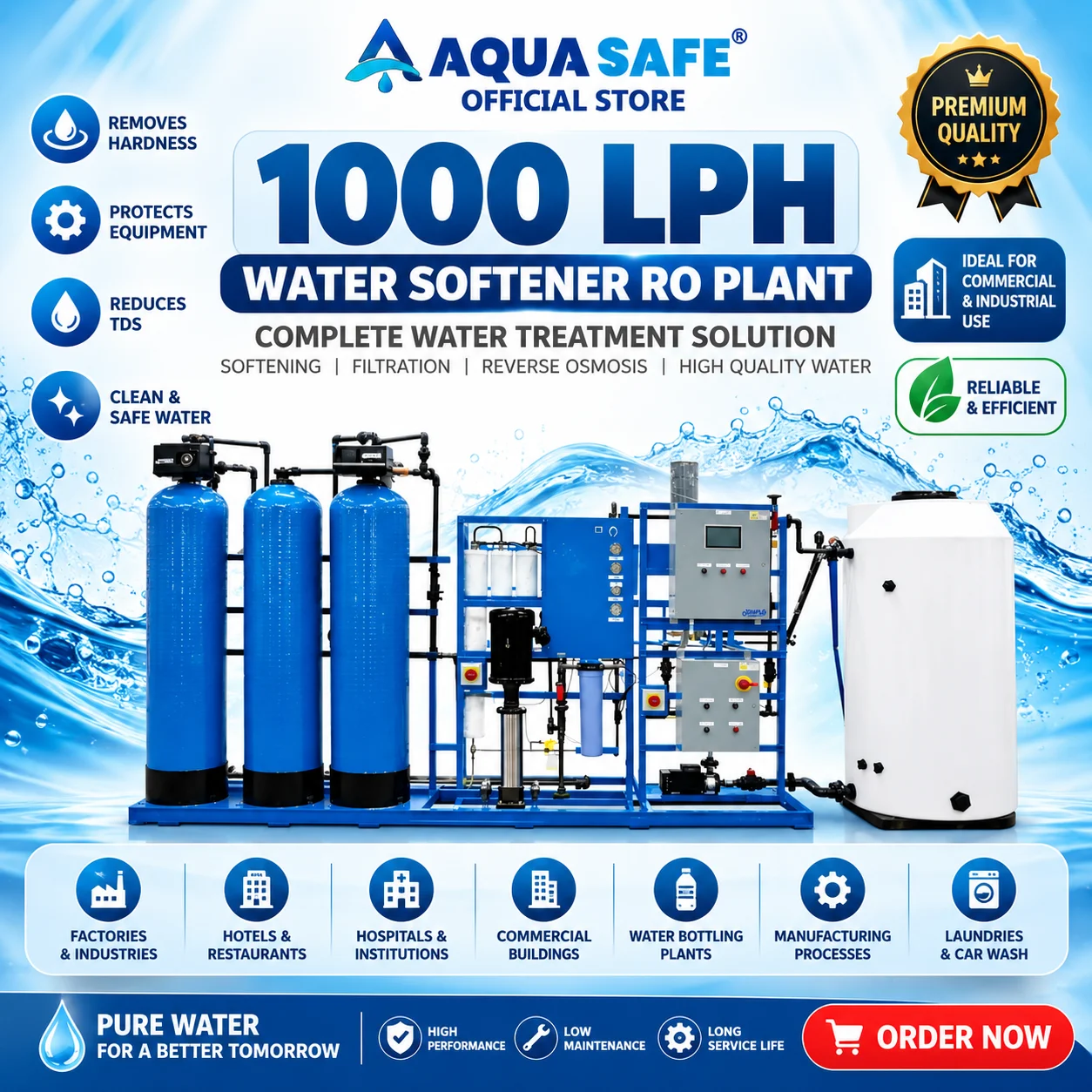
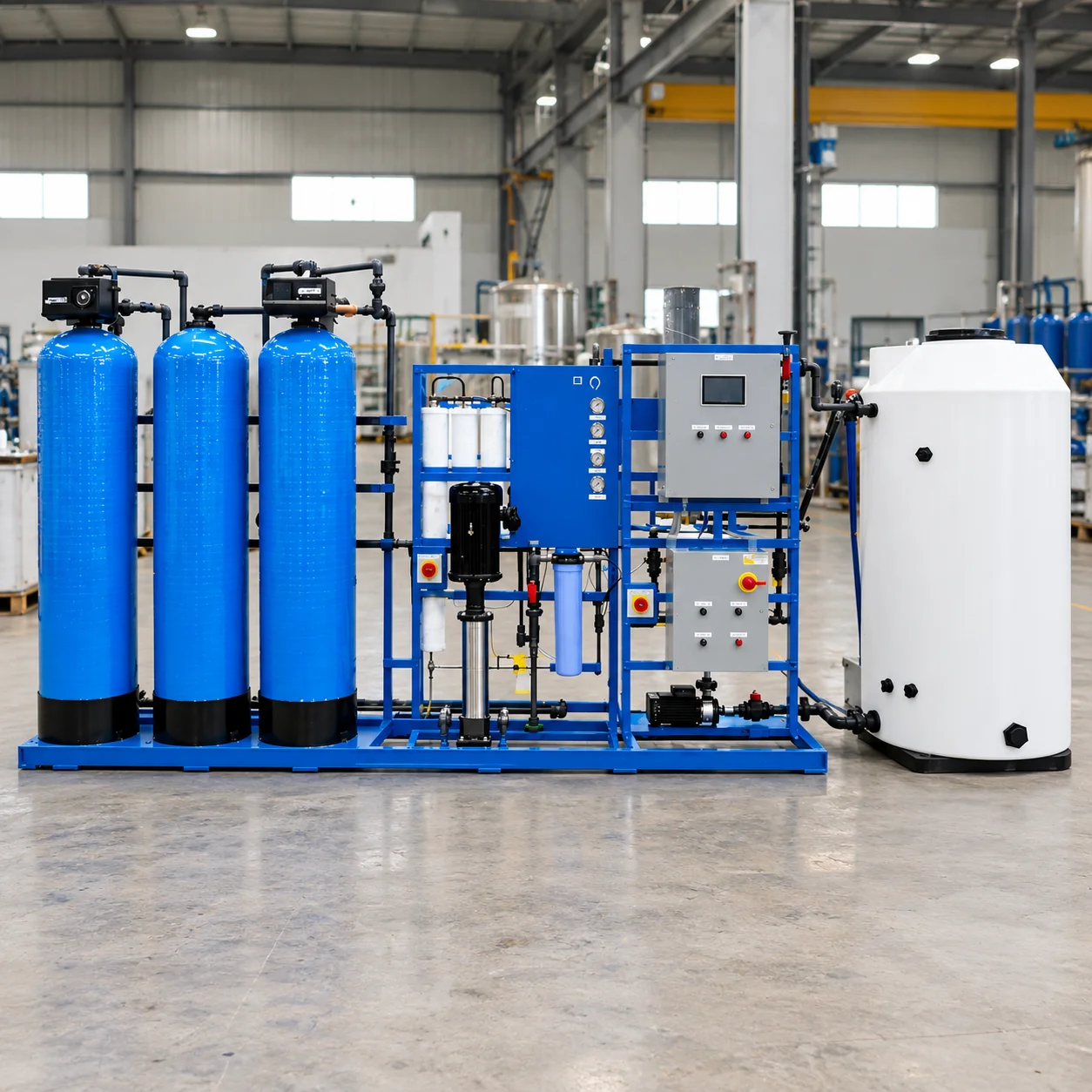


Aqua Safe 1000 LPH RO Plant in Pakistan
₨ 1,100,000.00 Original price was: ₨ 1,100,000.00.₨ 950,000.00Current price is: ₨ 950,000.00.
The Aqua Safe 1000 LPH Water Softener RO Plant is designed for commercial and industrial water treatment applications that require a consistent supply of treated water. With a nominal production capacity of up to 1,000 litres per hour, this system is suitable for businesses, factories, commercial buildings, hotels, restaurants, and other facilities that require a high-volume water treatment solution.
This water treatment system combines water softening pretreatment with Reverse Osmosis (RO) technology, subject to the final system configuration. The water softener helps reduce hardness-causing minerals, while the RO membrane reduces dissolved salts and other impurities from the incoming water. Together, these treatment processes can help improve water quality and protect downstream equipment when properly designed for the source water.
Key Features and Benefits
- 1000 LPH Capacity: Designed for a nominal treated-water production rate of approximately 1,000 litres per hour under specified operating conditions.
- Water Softening Pretreatment: Helps reduce calcium and magnesium hardness when a suitable ion-exchange softener is installed.
- Reverse Osmosis Technology: Reduces dissolved salts and many other impurities, depending on membrane selection and feed-water quality.
- Commercial Applications: Suitable for businesses and facilities with significant daily water requirements.
- Equipment Protection: Proper softening pretreatment can help reduce hardness-related scaling on RO membranes.
- Customizable Configuration: Pretreatment filters, RO membranes, pumps, control systems and storage arrangements can be selected according to the application.
- Continuous Water Supply Planning: Can be integrated with an appropriate treated-water storage tank to support fluctuating demand.
- Aqua Safe Brand: A water treatment solution for customers in Pakistan seeking commercial and industrial water filtration equipment.
How Does the Water Softener RO Plant Work?
Stage 1: Raw Water Supply
Raw water enters the treatment system from the available water source, such as a borewell, municipal supply or another suitable source. Feed-water testing is recommended before selecting the equipment.
Stage 2: Pretreatment Filtration
Appropriate sediment and other pretreatment filters can help remove suspended particles and protect downstream components. The exact filtration stages depend on the raw-water quality.
Stage 3: Water Softening
An ion-exchange water softener replaces hardness-causing calcium and magnesium ions with sodium ions. This helps reduce the risk of scale formation in the RO system. The softener requires regeneration using salt, according to its design and operating conditions.
Stage 4: Reverse Osmosis Treatment
A high-pressure pump sends pretreated water through the RO membrane. The membrane separates a portion of dissolved salts and other impurities from the feed water, producing permeate (treated water) and a reject-water stream.
Stage 5: Treated Water Storage
The treated water can be collected in a suitably sized storage tank. Tank capacity should be selected according to daily consumption, peak demand and the plant’s operating schedule.
Stage 6: Optional Final Treatment
Depending on the intended use, additional treatment such as UV disinfection, remineralization or other polishing stages may be considered. These options should be selected based on water testing and the required water-quality standard.
Technical Specifications
| Specification | Details |
|---|---|
| Brand | Aqua Safe |
| Product Type | Commercial Water Softener RO Plant |
| Nominal Capacity | 1000 LPH |
| Capacity in Litres | Approximately 1,000 litres per hour under specified conditions |
| Treatment Technologies | Water softening and Reverse Osmosis, subject to configuration |
| Water Softener Type | Ion-exchange softener, if included in the supplied configuration |
| Water Source | Borewell, municipal or other suitable feed water, subject to testing |
| RO Membrane | To be confirmed according to the selected model |
| Feed Pump / High-Pressure Pump | To be confirmed according to the selected model |
| Pretreatment Filters | To be confirmed according to the supplied configuration |
| Softener Regeneration | Salt-based regeneration for a conventional ion-exchange softener |
| Control System | To be confirmed according to the selected model |
| Storage Tank | Optional or configuration-dependent |
| Installation | Site-dependent |
| Country of Sale | Pakistan |
| Brand Website | https://aquasafe.pk/ |
Important: Confirm the final equipment list, operating pressure, membrane quantity, pump rating, electrical requirements, recovery rate, dimensions, warranty and actual rated capacity with the supplier before publishing them as fixed specifications.
Applications of the Aqua Safe 1000 LPH Water Softener RO Plant
This commercial water treatment system may be suitable for:
- Factories and industrial facilities
- Hotels and guest houses
- Restaurants and commercial kitchens
- Schools, colleges and other institutions
- Hospitals and healthcare facilities, subject to the required water-quality standards
- Commercial buildings and offices
- Laundries and washing facilities
- Food and beverage processing, subject to applicable quality requirements
- Manufacturing processes requiring treated water
- Commercial water supply and refill operations, subject to local regulations and appropriate disinfection
Why Is Water Softening Important Before RO?
Hard water contains minerals such as calcium and magnesium. Under suitable conditions, these minerals can form scale on RO membranes and other equipment.
A correctly sized water softener can reduce hardness before water enters the RO system. This may help reduce scaling, support membrane performance and lower maintenance requirements.
Water softening alone does not remove all dissolved salts. The RO stage is used to reduce dissolved salts, while other contaminants may require additional treatment depending on their nature and concentration.
Installation Requirements
Before installing the Aqua Safe 1000 LPH Water Softener RO Plant, consider the following:
- Water Analysis: Test feed water for TDS, hardness, pH, turbidity, iron and other relevant parameters.
- Suitable Location: Provide adequate space for the plant, pretreatment equipment, softener and storage tanks.
- Water Supply: Ensure the incoming supply can provide the required flow and pressure.
- Drainage: Provide suitable drainage for softener regeneration wastewater and RO reject water.
- Electrical Supply: Confirm the required voltage, phase, power rating and protection arrangements for the selected equipment.
- Storage and Distribution: Size the treated-water tank and distribution pump according to actual demand.
- Commissioning: Check operating pressure, flow rate, permeate quality, reject flow and softener regeneration settings after installation.
Professional installation is recommended for reliable operation and correct system adjustment.
Maintenance and Care
Regular maintenance is essential for efficient operation.
- Replace or clean pretreatment filters according to their condition and the manufacturer’s recommendations.
- Check softener salt levels and ensure that regeneration occurs correctly.
- Monitor feed-water hardness and inspect for possible hardness leakage from the softener.
- Record RO feed pressure, permeate flow, reject flow and permeate TDS.
- Clean RO membranes when performance indicators show that cleaning is necessary.
- Sanitize storage tanks and distribution lines as appropriate for the intended use.
- Replace membranes and other consumables according to performance, water quality and manufacturer guidelines.
Maintenance intervals depend on feed-water quality, operating hours and system design.
Benefits for Businesses in Pakistan
The Aqua Safe 1000 LPH Water Softener RO Plant offers a scalable approach to commercial water treatment. It can help businesses address water hardness and dissolved-solids concerns through appropriately selected treatment stages.
For customers in Pakistan, the correct configuration should be based on local feed-water conditions, particularly where borewell water has high hardness, elevated TDS, iron or suspended solids. A water analysis helps determine the required pretreatment, membrane arrangement, expected output and maintenance needs.
Frequently Asked Questions (FAQs)
Q1. What does 1000 LPH mean?
1000 LPH means 1,000 litres per hour. This is the nominal rated capacity, and actual RO production can vary with feed-water temperature, TDS, pressure, membrane selection and operating conditions.
Q2. What is a water softener RO plant?
It is a water treatment arrangement that uses a water softener to reduce hardness and an RO system to reduce dissolved salts and other impurities. The exact stages depend on the supplied configuration.
Q3. Does a water softener remove TDS?
A conventional ion-exchange water softener reduces calcium and magnesium hardness but generally does not substantially reduce total dissolved solids. The RO stage performs the main dissolved-salt reduction.
Q4. Is the Aqua Safe 1000 LPH plant suitable for borewell water?
It may be suitable, but the correct design depends on the borewell water analysis. High hardness, iron, silica, turbidity and TDS can affect equipment selection and operating performance.
Q5. Can this plant supply 1,000 litres every hour?
The nominal rating is 1,000 LPH under specified operating conditions. Actual production should be confirmed for the intended feed water and installation. Daily production also depends on operating hours and downtime.
Q6. Does the plant require salt?
If the system includes a conventional ion-exchange water softener, salt is generally required for resin regeneration. Salt consumption depends on feed-water hardness, water usage and softener design.
Q7. Does RO water require a storage tank?
A storage tank is often useful when demand varies throughout the day. The appropriate size depends on consumption patterns and the plant’s production schedule.
Q8. Can the plant be used for drinking water?
RO treatment can reduce many dissolved contaminants, but the finished water must be tested against applicable drinking-water standards. Appropriate disinfection, hygienic storage and distribution may also be required. Suitability for drinking cannot be confirmed from capacity alone.
Q9. How often should the RO membranes be replaced?
There is no universal replacement interval. Membrane life depends on feed-water quality, pretreatment, operating conditions, maintenance and cleaning. Monitor performance and follow the membrane manufacturer’s recommendations.
Q10. Does the plant remove bacteria and viruses?
RO membranes can provide a barrier to many microorganisms under appropriate conditions, but the complete plant should not be assumed to provide microbiologically safe water without validated design, maintenance, disinfection and testing.
Q11. Can this plant be customized?
The configuration may be customized according to water analysis, required output, feed-water conditions, storage requirements and the intended application. Confirm available options with Aqua Safe before ordering.
Q12. Is installation included in the price?
Installation, transportation, commissioning, storage tanks and accessories depend on the supplier’s quotation. Confirm these items before placing an order.
Order the Aqua Safe 1000 LPH Water Softener RO Plant in Pakistan
Looking for a commercial water treatment solution for your business? Explore Aqua Safe water filtration products and contact the supplier to confirm the plant configuration, price, installation options and availability.
Website: https://aquasafe.pk/
Contact Aqua Safe with your feed-water test report and estimated daily water requirement to help determine the most appropriate configuration.
Related products

500 LPH Mineral...


Reviews
There are no reviews yet.